

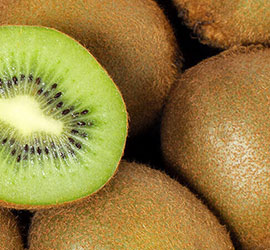
Originally from China, it arrived in Italy in the 1960s. The kiwi is a lianiform plant and in the wild it climbs around the trunk of other trees because its trunk is unable to support the weight of the rest of the plant; for this reason, in cultivation it is supported with suitably prepared stable structures.
The plant of most kiwis is also characteristic of being dioecious, i.e., the male and female flowers are found on different individuals: for this reason, it is necessary to plant at least one male specimen for every 6-7 females, in order to ensure fertilisation and therefore the production of fruit.
Kiwis are harvested between October and November and the fruit is then stored in the refrigerator for a few months, at most until June in professional cultivation.
A kiwi plant in full production can yield up to 30-50 kg of fruit. Those found on the market in the summer months are usually not Italian but come from the other hemisphere.